

Understanding the Fundamentals of Active and Passive Voice
Strong writing depends heavily on sentence structure, tone, and grammar choices. Understanding the distinction between active and passive voice allows writers to control narrative pacing, direct reader attention, and communicate complex thoughts with precision. Every English sentence contains a relationship between the subject performative element and the verb action. Recognizing how grammatical voice alters this relationship is essential for effective communication across academic, professional, and creative domains.
The Core Mechanics of Subject, Verb, and Object
At the heart of grammatical voice is the relationship between three fundamental elements: the subject, the verb, and the direct object. In standard English sentence construction, the subject performs the action expressed by the verb, while the object receives that action. Shifting the grammatical voice does not change the fundamental truth of what occurred, but it alters which element takes center stage in the sentence hierarchy.
Mechanics of the Active Voice Construction
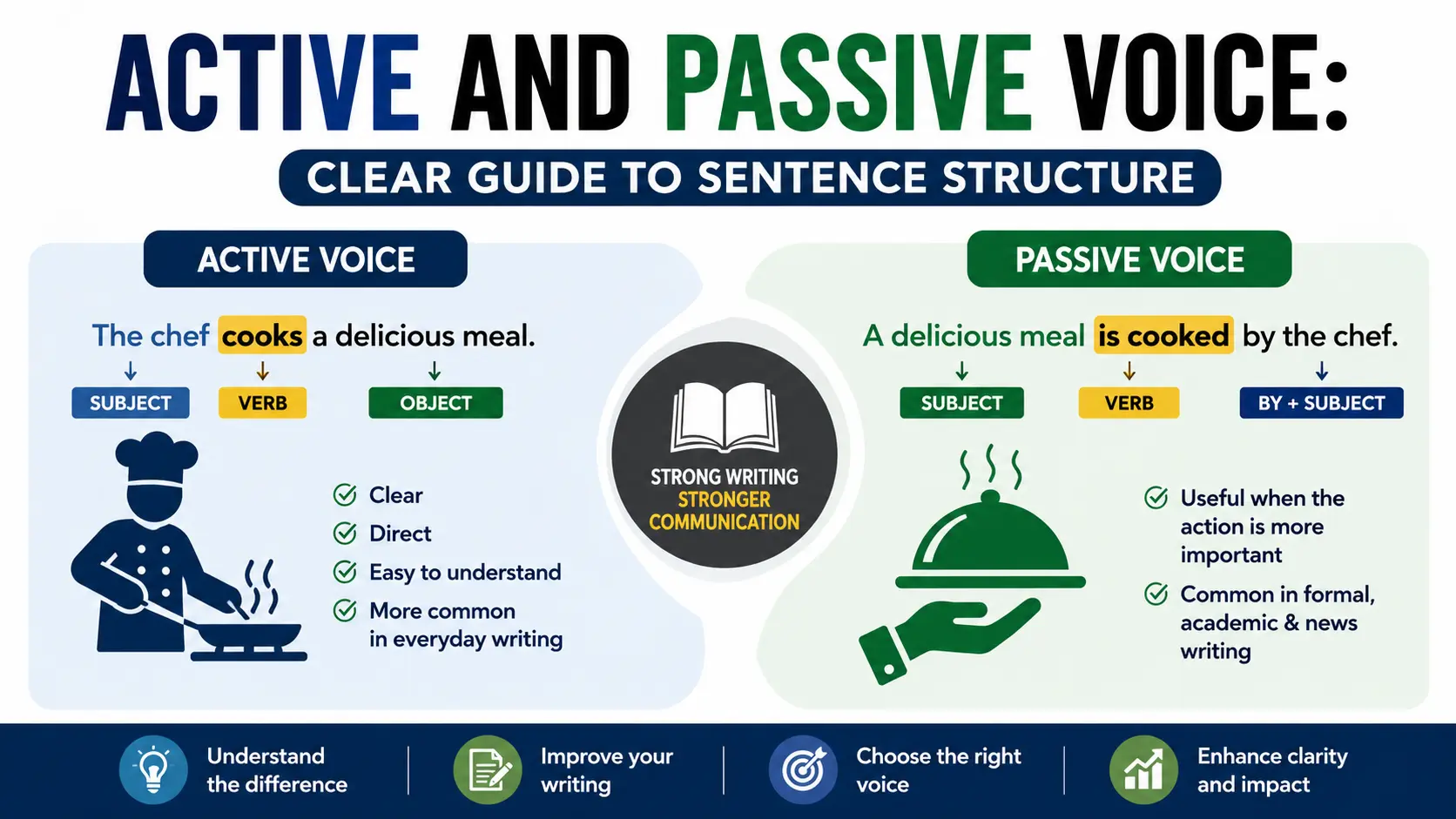
Active voice occurs when the subject of a sentence directly performs the action stated by the main verb. This construction follows a direct line of sight: Subject $\rightarrow$ Verb $\rightarrow$ Object. Because the actor comes first, active sentences naturally convey energy, accountability, and clarity.
Direct Action and Subject Primacy in Sentences
By placing the actor at the beginning of the sentence, active voice creates direct, dynamic prose. For example, in “The research team published the study,” the subject (“the research team”) actively performs the verb (“published”). This direct arrangement eliminates unnecessary wordiness and makes reading easier and more engaging.
Mechanics of the Passive Voice Construction
Passive voice reverses the standard sentence relationship by making the target of the action the subject of the sentence. Instead of the actor driving the action, the person or item receiving the action becomes the primary focus, while the original actor is moved to a prepositional phrase or omitted entirely.
Shifting Focus to the Object and Action Receiver
In passive constructions, the verb phrase always requires a form of the auxiliary verb to be paired with a past participle (e.g., “was written,” “is being analyzed”). In the sentence “The study was published by the research team,” the focus shifts to “the study.” If the actor is removed, as in “The study was published,” the sentence becomes agentless passive voice.
Key Differences Between Active and Passive Voice
Distinguishing between active and passive voice requires analyzing who or what is performing the action. Active voice emphasizes who did something, whereas passive voice highlights what was done or what was affected by the action.
Sentence Structure and Syntactic Breakdown
The structural difference between these two forms impacts word count, clarity, and tone. Active sentences are generally concise and direct, while passive sentences tend to be longer due to auxiliary verbs and prepositional phrases.
How to Convert Active Voice to Passive Voice
Converting sentences between active and passive voice is a valuable editing skill. Changing active voice to passive requires identifying the direct object and turning it into the new grammatical subject.
Tense Shifts and Auxiliary Verb Adjustments
To transform a sentence from active to passive, move the direct object to the front, conjugate the verb to be to match the original tense, add the main verb’s past participle, and place the original subject after the preposition “by.” Conversely, to make a passive sentence active, find the actor in the “by” phrase, move them to the subject position, and simplify the verb.
Strategic Uses of Active Voice in Writing
Active voice is the preferred choice for most writing because it promotes clarity, conciseness, and engagement. Digital readers and professional editors prefer direct phrasing over convoluted sentence structures.
Enhancing Engagement in Business and Creative Work
In business communications, marketing materials, and creative narratives, active voice creates momentum. Statements like “Our team solved the technical issue” convey confidence and ownership far more effectively than “The technical issue was solved by our team.”
When to Strategically Choose Passive Voice
Although writing guides often favor active voice, passive voice serves an important purpose. Knowing when to use passive voice strategically is a sign of mature writing.
Scientific Writing, Anonymity, and Tactful Phrasing
Passive voice is widely used in scientific reports and technical documentation where the process matters more than the person doing it (e.g., “The solution was heated to 100°C”). It is also useful in sensitive situations where you want to avoid blaming someone directly (e.g., “An error was made on the report”).
Common Pitfalls and Misconceptions
A common misconception among writers is confusing passive voice with the past tense. Passive voice is a grammatical voice, not a tense, and can exist in past, present, or future tenses.
Distinguishing Passive Voice from Past Tense
A sentence can be in the past tense while remaining completely active (e.g., “She ran five miles”). Conversely, passive voice can occur in the present or future tense (e.g., “The house is cleaned daily” or “The contract will be signed tomorrow”). Passive voice always requires an auxiliary be verb combined with a past participle.
Impact on Readability and SEO Writing
In web writing and search engine optimization (SEO), readability directly affects user engagement and page bounce rates. Search engines prioritize content that is clear and easy to read.
Clarity Metrics and Digital Audience Engagement
Content tools and readability algorithms (such as the Flesch-Kincaid scale) flag excessive passive voice because it increases cognitive load. Keeping passive voice usage below 10-15% across an article keeps online readers engaged and improves accessibility across device types.
Practical Exercises and Real-World Examples
Mastering active and passive voice requires consistent practice in spotting and revising sentence structures. Comparing both forms side-by-side demonstrates how voice influences tone and narrative focus.
Converting Everyday Sentences for Better Clarity
Consider the sentence: “A new software update was released by the development team.” Rephrasing it into active voice—”The development team released a new software update”—instantly makes it cleaner, more energetic, and easier to digest.
Reference & Conversion Tables
Active vs Passive Voice Across Grammatical Tenses
| Grammatical Tense | Active Voice Example | Passive Voice Example |
| Simple Present | The engineer inspects the bridge. | The bridge is inspected by the engineer. |
| Simple Past | The author wrote a bestseller. | A bestseller was written by the author. |
| Present Perfect | The committee has approved the budget. | The budget has been approved by the committee. |
| Future (Will) | The manager will present the report. | The report will be presented by the manager. |
Comparative Matrix: Strategic Voice Application
| Feature Criteria | Active Voice Choice | Passive Voice Choice |
| Primary Focus | The actor / performative subject | The action receiver / result |
| Sentence Length | Concise and direct | Expanded / auxiliary heavy |
| Tone & Style | Direct, authoritative, energetic | Objective, neutral, formal |
| Ideal Context | Blogs, emails, marketing, narrative fiction | Lab reports, legal briefs, sensitive news |
Frequently Asked Questions
Q1: What is the main difference between active and passive voice?
In active voice, the subject performs the verb’s action (e.g., “The dog chased the ball”). In passive voice, the subject receives the action (e.g., “The ball was chased by the dog”).
Q2: Is passive voice grammatically incorrect?
No, passive voice is completely grammatically correct. However, using it too much can make writing wordy, indirect, and harder to read, which is why writers are often encouraged to use active voice instead.
Q3: How do I easily identify passive voice in my writing?
Look for a form of the verb to be (am, is, are, was, were, been, being) followed immediately by a past participle verb (e.g., “was completed”, “is conducted”), often accompanied by a “by [actor]” phrase.
Q4: When should I intentionally use passive voice?
Use passive voice when the actor is unknown or irrelevant (e.g., “The vault was locked overnight”), in scientific writing focused on procedures, or when you need to handle sensitive news tactfully.
Q5: Does using passive voice affect SEO performance?
Yes, indirectly. High amounts of passive voice can make content harder to read, lower readability scores, and lead to higher bounce rates from visitors looking for quick, clear answers.
Conclusion
Mastering active and passive voice gives writers greater control over their style and messaging. Active voice provides directness, energy, and clarity, making it ideal for business, digital, and everyday communication. Passive voice, when used intentionally, provides neutrality and focus in technical, scientific, and sensitive contexts. By understanding how to balance both structures effectively, you can write clear, engaging, and purposeful content across any medium.